Educational Baby Toys 0-12 Months: The Science-Backed Guide to Early Learning
Introduction
The first year of life represents the most intensive learning period humans ever experience. Your baby’s brain grows from about 400 grams at birth to roughly 1,000 grams by their first birthday—tripling in size while forming over one million neural connections per second during peak development. This extraordinary growth isn’t passive; it’s shaped by every experience, interaction, and object your baby encounters. Educational baby toys serve as tools for this learning, but not all toys labeled “educational” actually support development. Understanding what makes a toy truly educational helps you invest wisely in items that genuinely enhance your baby’s learning during this critical first year.
Redefining “Educational” for Babies
The toy industry has co-opted the term “educational,” slapping it on countless products that may do little to support actual learning. True educational baby toys for 0-12 months share specific characteristics grounded in developmental science rather than marketing claims.
Appropriate Challenge: Educational toys provide tasks slightly beyond your baby’s current abilities—difficult enough to require effort but achievable with practice. This “sweet spot” of challenge promotes growth without causing frustration. Toys that are too easy become boring. Toys that are too difficult lead to giving up. The right challenge keeps babies engaged in productive learning.
Open-Ended Design: The most educational toys don’t dictate exactly how to play. They allow exploration, experimentation, and creative use. A simple ball can be grasped, thrown, rolled, chased—each interaction teaching different concepts. Electronic toys that respond the same way to every input actually limit learning by reducing opportunities for discovery.
Multi-Sensory Engagement: Babies learn through all their senses. Educational toys engage multiple sensory systems simultaneously—they’re interesting to look at, pleasant to touch, safe to mouth, and perhaps make sounds. This multi-sensory input builds more complex neural connections than single-sense stimulation.
Responsive Feedback: Educational toys respond to babies’ actions in clear, immediate ways. Shake a rattle, hear sound. Drop a block, hear impact. This cause-and-effect feedback teaches foundational concepts about how the world works while motivating continued exploration.
Natural Materials: While not an absolute requirement, natural materials offer educational advantages. They provide varied textures, appropriate weights, and authentic properties that teach real information about the physical world. A wooden block teaches about wood—its weight, grain, warmth. A plastic block teaches only about plastic.
Educational Priorities by Developmental Stage
Your baby’s learning needs change dramatically across the first year. Understanding these evolving priorities helps you choose toys that match their current capabilities and emerging skills.
0-3 Months: Sensory Foundations: During the early weeks, babies primarily need sensory experiences that help them organize incoming information. High-contrast visual patterns support developing vision. Varied textures provide tactile input. Gentle sounds stimulate auditory processing. “Educational” at this stage means sensory-rich rather than concept-focused. Black and white toys, soft rattles, and textured blankets all qualify as educational because they support sensory system development.
3-6 Months: Motor Exploration: As intentional movement emerges, educational focus shifts to supporting physical development. Toys that encourage reaching, grasping, and manipulation teach babies about their body’s capabilities. The learning isn’t abstract—it’s deeply physical, building the foundation for all later motor skills. Rattles, soft balls, and grasping toys become educational tools by providing practice opportunities for emerging abilities.
6-9 Months: Cause and Effect: Once babies can reliably grasp and manipulate objects, cognitive learning accelerates. They become fascinated with cause and effect relationships—”If I do this, that happens.” Educational toys at this stage clearly demonstrate these relationships. Toys with buttons that make sounds, blocks that stack, or containers that hold objects all teach fundamental concepts about causation and object properties.
9-12 Months: Problem Solving: As the first birthday approaches, babies show emerging problem-solving abilities. They can plan sequences of actions to achieve goals. Educational toys should provide appropriate cognitive challenges—shape sorters (though they may not master them yet), simple puzzles, nesting toys, and items requiring multi-step manipulation. These toys build persistence, planning, and problem-solving skills that will serve them throughout life.
Categories of Truly Educational Baby Toys
Certain toy categories consistently support learning across multiple developmental domains during the first year.
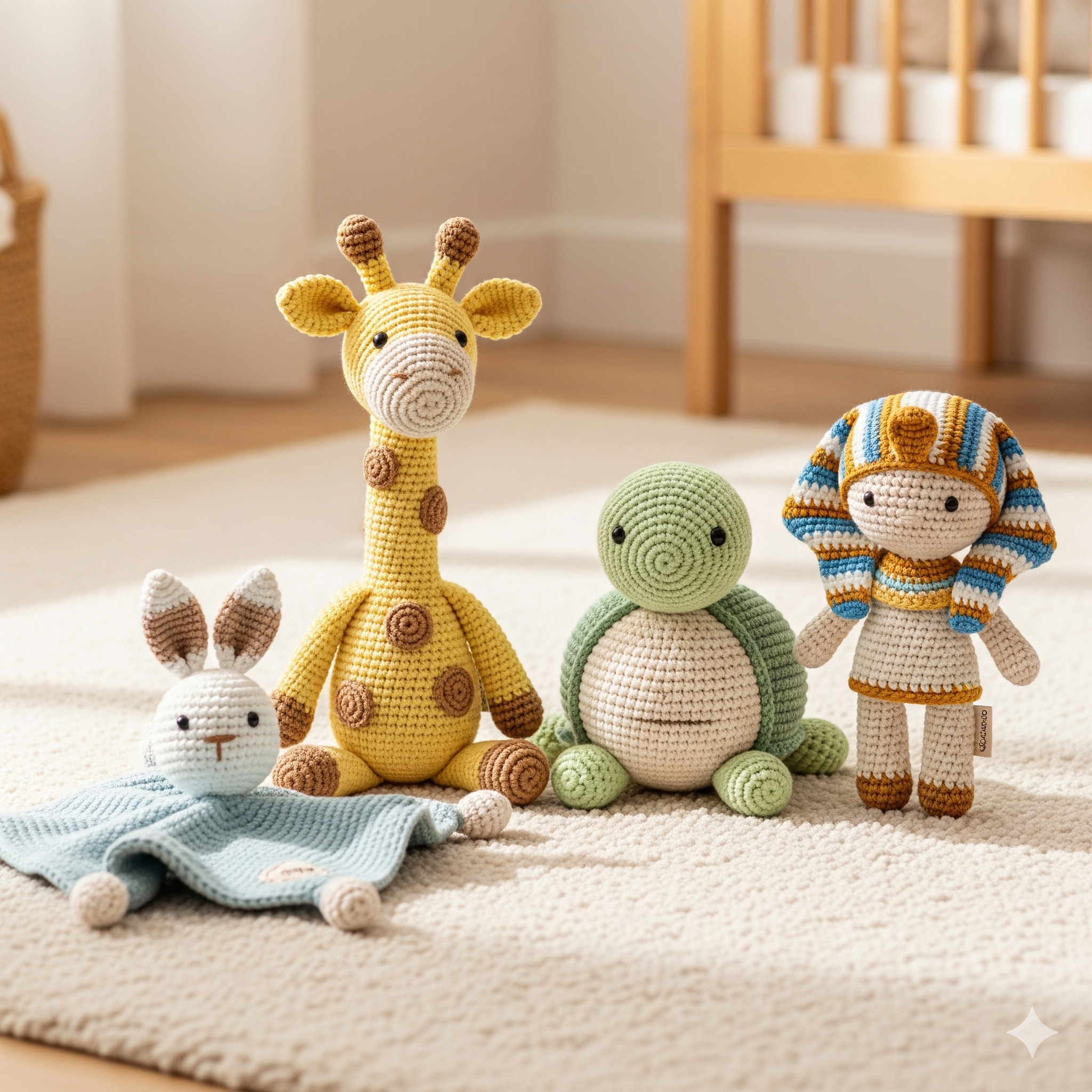
Sensory Toys: Items with varied textures, sounds, and visual interest support the sensory processing development underlying all later learning. Handmade crochet toys excel here—the varied stitch patterns provide rich tactile experiences, natural fillings create gentle sounds, and the flexibility adapts to babies’ changing grip abilities. Unlike electronic toys with predetermined responses, sensory toys allow babies to discover properties through their own exploration.
Stacking and Nesting Toys: These teach size relationships, spatial reasoning, and planning. Babies learn that bigger goes on bottom, that objects can contain other objects, and that actions have sequences. While simple, these concepts are foundational for later mathematical and logical thinking. Natural material versions provide additional learning through varied weights and textures.
Balls: Perhaps the most versatile educational toy, balls teach physics concepts like rolling, bouncing, and trajectory. They support gross motor development through chasing and throwing. They encourage social interaction through back-and-forth rolling games. Different sizes and materials teach that similar objects can have different properties. Textured balls, especially handmade crochet versions, add grip practice and tactile learning to these benefits.
Shape Sorters and Simple Puzzles: These introduce problem-solving and spatial reasoning. While babies may not successfully sort shapes until closer to 18 months, exposure during late infancy allows exploration of the concepts. The repeated attempts to make pieces fit teaches persistence and trial-and-error learning—skills as valuable as eventually solving the puzzle.
Building Blocks: Blocks support countless learning objectives—balance, spatial relationships, cause and effect, creativity, and fine motor skills. They’re the ultimate open-ended toy, usable from infancy (when babies just grasp and mouth them) through childhood (when they build complex structures). Natural wood blocks provide authentic physics experiences that plastic cannot match.
Mirrors: Babies are fascinated by faces, including their own. Safe, unbreakable mirrors support visual tracking, focus development, and eventually self-recognition (though that comes after 12 months). They make tummy time more engaging by providing something interesting to look at while strengthening neck and upper body muscles.
Musical Instruments: Simple instruments like shakers, drums, and bells teach rhythm, cause and effect, and auditory discrimination. They support bilateral coordination when babies use both hands. The connection between action and sound is immediately clear and endlessly fascinating during infancy.
What NOT to Look For
Understanding what doesn’t support learning helps you avoid wasted money on ineffective toys marketed as educational.
Electronic Teaching Toys: Devices claiming to teach letters, numbers, or words during infancy provide minimal educational value. Babies under 12 months need physical, sensory, and motor experiences—not abstract symbols. The passive entertainment these devices provide doesn’t support the active learning that builds infant brains. Research consistently shows that simple toys outperform electronic alternatives for early development.
Overly Complex Toys: Toys with too many features, lights, sounds, and options overwhelm rather than educate. They encourage quick button-pushing rather than sustained exploration. Babies learn more from toys that do one or two things well than from toys attempting to do everything.
Age-Inappropriate Toys: Toys designed for older children frustrate babies who can’t yet manipulate them. Marketing claims like “grows with your child” often mean the toy isn’t ideally suited for any particular stage. Stage-specific toys that perfectly match current abilities provide better learning experiences.
Battery-Dependent Toys: Beyond environmental concerns, battery-operated toys create dependency on parent intervention when batteries die. They also limit the learning to whatever the toy is programmed to do. Simple toys that don’t require batteries allow unlimited, child-directed exploration.
The Undervalued Role of Everyday Objects
Some of the most educational “toys” for babies aren’t toys at all but household items used under supervision.
Kitchen Items: Wooden spoons, safe plastic containers, measuring cups—these items fascinate babies. They provide authentic experiences with real-world objects. The weight of a metal spoon differs from a wooden one. Containers demonstrate that objects can hold other objects. These ordinary items teach genuine concepts about the physical world.
Natural Objects: Supervised exploration of safe natural items—smooth stones, pinecones, shells—provides sensory experiences synthetic toys cannot replicate. The varied textures, weights, and temperatures teach about material properties while connecting babies to the natural world.
Fabric Items: Different fabric textures—silk, cotton, wool, denim—each provide unique tactile information. Safe fabric scraps become educational materials for supervised texture exploration.
The Critical Role of Parent Interaction
Even the most perfectly designed educational toy provides limited value without parent engagement. Research consistently shows that adult interaction transforms toys from simple objects into powerful learning tools.
Narration: Describing what your baby experiences builds language comprehension long before they speak. “You’re shaking your rattle—hear the sound it makes?” connects words with experiences, laying groundwork for later language development.
Scaffolding: Providing just enough help that your baby can succeed with effort—but not so much that you’re doing it for them—supports learning. If they’re trying to stack blocks and struggling, you might stabilize the bottom block, allowing them to focus on placement of the top one.
Turn-Taking: Even simple games like rolling a ball back and forth teach social skills. Taking turns with toys demonstrates shared attention and reciprocal interaction—foundations for all later social learning.
Enthusiasm: Your interest makes toys interesting. When you show excitement about a simple ball, your baby learns that exploration and discovery are valuable activities worth engaging in repeatedly.
Creating an Educational Play Environment
The overall environment affects how effectively toys support learning.
Organized Simplicity: Rather than overwhelming your baby with all toys simultaneously, rotate them. Having 5-7 toys available at once, rotated every few days, maintains novelty without creating chaos. This focused selection actually increases engagement compared to rooms full of options.
Safe Exploration Space: Babies learn through movement—reaching, crawling, pulling up. They need safe floor space where they can explore toys without restriction. Baby-proofed areas where they can move freely support both physical and cognitive development.
Natural Light: Whenever possible, position play areas near natural light sources. Natural light supports circadian rhythm development and provides better visual contrast than artificial lighting, helping babies see toy details more clearly.
Calm Atmosphere: Background noise from television or loud music can interfere with babies’ ability to focus on toys and their own vocalizations. Quiet or gently musical environments support sustained attention and learning.
The Montessori Approach to Educational Toys
Maria Montessori’s educational philosophy offers valuable insights for selecting baby toys.
Montessori emphasized reality over fantasy during infancy. Babies benefit from toys representing real objects—animals that look like actual animals, vehicles resembling real vehicles. The fantastical creatures and exaggerated designs common in baby toys come later when imagination develops.
She also advocated for natural materials and beauty. Toys need not be garish to engage babies. Beautifully crafted natural material toys capture attention while teaching authentic properties of materials.
Independence was central to Montessori philosophy. Toys should enable babies to play independently rather than requiring constant adult operation. Simple toys that babies can manipulate themselves support developing autonomy and confidence.
Economic Considerations
Quality educational toys cost more than mass-produced alternatives. Understanding this investment helps parents make informed choices.
Cost Per Use: A $30 handmade toy used daily for months costs pennies per use. A $5 toy that breaks quickly or never engages your baby costs more per actual use despite lower initial price.
Multi-Child Use: Quality toys last through multiple children. They can be passed to siblings, cousins, or friends, or sold secondhand. This extended life justifies higher initial cost while reducing overall environmental impact.
Developmental Value: While harder to quantify, the enhanced development supported by quality toys provides returns throughout life. Early motor skills, problem-solving abilities, and cognitive foundations built through quality play experiences don’t show up on receipts but profoundly impact later success.
Safety Remains Paramount
No toy is educational if it’s unsafe. Educational value never supersedes safety considerations.
All toys for babies under 12 months must pass the “choke test”—they cannot fit through a cylinder 1.25 inches in diameter. They must have no detachable small parts, no sharp edges, and no toxic materials. Natural material toys from reputable makers meet these standards while providing superior educational value.
Regular inspection of all toys ensures continued safety as items age and potentially develop wear that could create hazards.
Measuring Educational Impact
Parents often wonder if their toy choices are actually supporting development. While formal assessment isn’t necessary, observation reveals educational effectiveness.
Does your baby return to the toy repeatedly? Sustained interest indicates appropriate challenge and genuine engagement. Does your baby use the toy in varied ways? Versatile use demonstrates that the toy supports creative thinking. Do you notice skill improvements? The true measure of an educational toy is whether your baby develops new abilities through interaction with it.
Conclusion:
Educational Baby Toys:
Learning Through Play
Educational baby toys for the first year aren’t about teaching academics or accelerating development beyond natural pace. They’re about providing appropriate experiences that support the extraordinary learning that naturally occurs during infancy.
The best educational investments during this critical year are simple, well-made toys from natural materials that support sensory, motor, and cognitive development through open-ended play. Combined with engaged parent interaction and organized environments, these toys become tools for building the foundations of all future learning.
Your baby doesn’t need expensive electronic gadgets claiming to make them smarter. They need opportunities to explore, manipulate, and discover using simple toys that respond predictably to their actions. That’s where real learning happens during this remarkable first year.
Why Us
Skill-Building Design
Handmade toys and essentials that support fine motor skills, hand-eye coordination, and sensory play.
Natural & Safe Materials
Soft, breathable cotton and bamboo yarns—gentle on babies and made with care.
Impact With Every Purchase
We empower women artisans and create responsible products aligned with key SDGs.