Developmental Toys for Newborns: Essential Tools for Your Baby’s First Milestones
Introduction
The first few months of your baby’s life are a period of extraordinary transformation. In just twelve weeks, your newborn progresses from reflexive movements and limited vision to intentional reaching, social smiling, and the beginnings of communication. This rapid development doesn’t happen automatically—it’s shaped by the experiences and interactions you provide. Developmental toys for newborns play a crucial role in supporting these early milestones, offering appropriate challenges that build foundational skills for all future learning.
What Makes a Toy “Developmental”?
Not all baby toys support development equally. Understanding what distinguishes truly developmental toys from mere entertainment helps you choose wisely for your newborn.
Developmental toys match specific milestones and emerging abilities. They provide challenges slightly beyond your baby’s current capabilities, encouraging them to stretch and grow without causing frustration. This concept of the “zone of proximal development” means the toy is neither too easy (boring) nor too difficult (frustrating) but just right to promote skill acquisition.
These toys also target specific developmental domains—physical, cognitive, sensory, social-emotional, or language. The best developmental toys often support multiple domains simultaneously. A simple rattle, for example, builds fine motor skills (physical), teaches cause and effect (cognitive), provides sensory stimulation (sensory), and creates opportunities for interaction (social).
Quality developmental toys are open-ended, allowing varied uses as your baby’s abilities evolve. A toy that does only one thing in one way becomes obsolete quickly. Toys that adapt to developing skills remain valuable across many months.
The Newborn Developmental Timeline
Understanding typical newborn development helps you select appropriate toys for each stage.
0-1 Month: Your newborn lives in a reflexive world. The grasp reflex causes their hand to close around anything touching their palm. The rooting reflex helps them find food. Vision is limited to about 8-12 inches—the distance to your face during feeding. Movements are random and uncoordinated. Developmental toys for this stage should be high-contrast for limited vision, lightweight for reflexive grasping, and provide gentle sensory stimulation without overwhelming.
1-2 Months: Babies start spending more time alert and begin making eye contact. They may smile socially, responding to your voice and face. Head control improves gradually. Vision extends a bit further. Toys should now support emerging head control during tummy time, encourage visual tracking with slow movement, and provide varied gentle sounds that capture attention.
2-3 Months: Intentional behavior emerges. Babies start batting at objects, though they often miss initially. They follow moving objects with their eyes more consistently. Cooing and vocal play begin. Developmental toys should hang within reach for batting practice, move slowly for tracking exercises, and have varied textures for the tactile exploration that’s intensifying.
3-4 Months: Hand-eye coordination improves dramatically. Babies deliberately reach for and grasp objects they see. They discover their hands and study them intently. Neck and upper body strength increase significantly. Toys should be easy to grasp, provide clear cause-and-effect feedback, and support the intense hand exploration that characterizes this stage.
Essential Developmental Toys for Newborns
While countless toys claim developmental benefits, certain categories consistently support newborn growth across domains.
High-Contrast Visual Toys: Newborns see high-contrast patterns most clearly. Black and white toys, cards, or books with simple shapes support visual development and focus practice. These don’t need to be complex—simple geometric patterns work beautifully. Handmade crochet toys in black and white cotton provide visual interest with safe tactile exploration.
Lightweight Rattles: Perhaps the quintessential developmental toy, rattles support reflexive grasping initially, then intentional grasping and shaking. They teach cause and effect, build hand strength, and provide auditory stimulation. Natural material rattles with gentle sounds work better than loud plastic versions that may startle sensitive newborns.
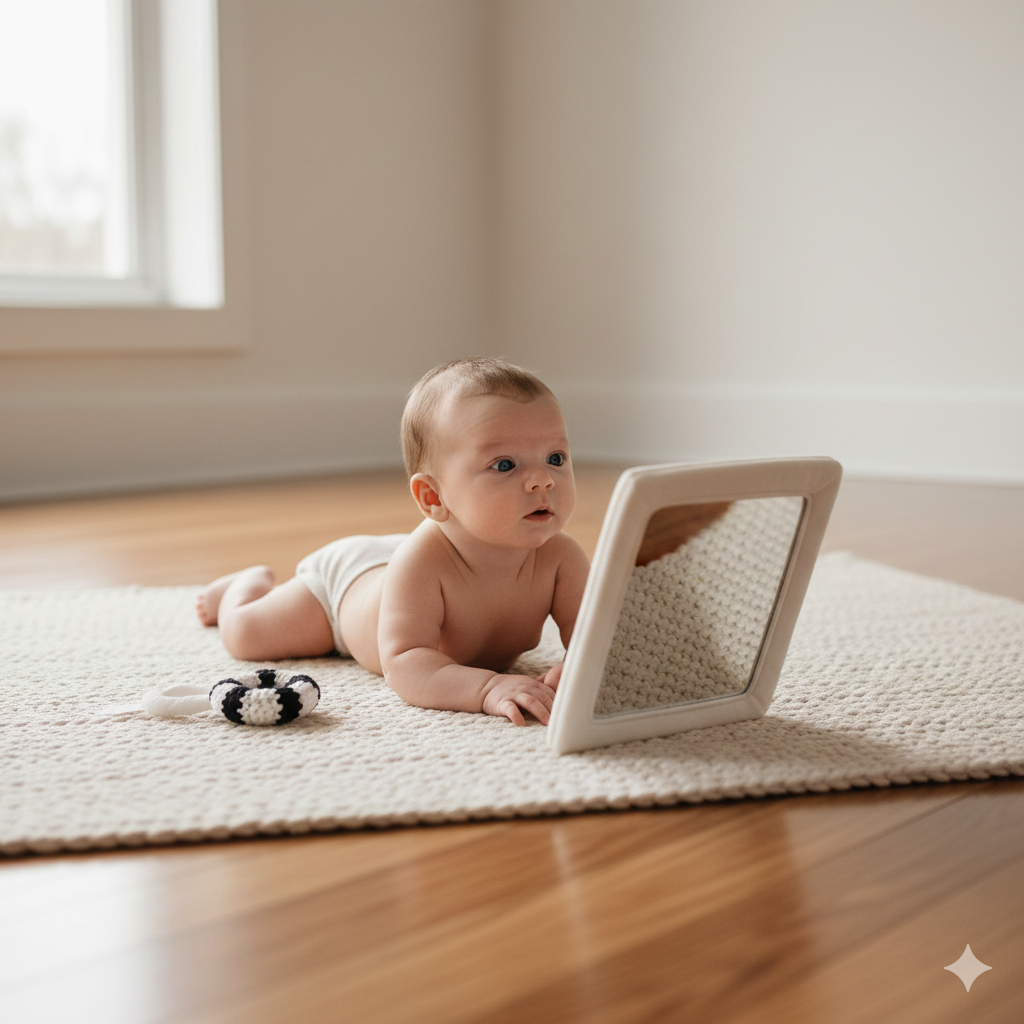
Soft Mirrors: Babies are fascinated by faces, even their own, though they won’t understand it’s their reflection yet. Safe, soft mirrors support visual tracking, focus development, and eventually self-recognition. They’re particularly valuable during tummy time, motivating babies to lift their heads.
Texture Balls: Soft balls with varied textures provide multiple sensory experiences. Easy-to-grasp designs support emerging motor skills. Rolling them slowly encourages visual tracking. Later, they support reaching and batting practice. Natural fiber balls, especially handmade crochet versions, offer superior texture variety compared to smooth plastic alternatives.
Activity Gyms: These overhead structures with hanging toys support many developmental areas. They encourage reaching, batting, grasping, and visual tracking. They make tummy time more engaging by providing interesting things to look at. Choose versions with detachable toys you can rotate to maintain interest.
Security Blankets: Soft blankets or small loveys become self-soothing tools and comfort objects. The tactile stimulation supports sensory development, while the emotional attachment promotes security and emotional regulation. Natural fibers like organic cotton provide superior breathability and sensory experience compared to synthetic alternatives.
Teething Toys: While newborns don’t teeth initially, oral exploration begins early. Safe, natural teething toys made from materials like natural rubber or organic cotton provide appropriate oral sensory input. Handmade options ensure no small parts can detach and become choking hazards.
Material Matters: Why Natural is Better for Newborn Development
The materials used in developmental toys significantly impact their effectiveness and safety.
Sensory Richness: Natural materials like cotton, bamboo, wool, and wood provide varied textures, temperatures, and weights that synthetic materials cannot replicate. This sensory variety supports more sophisticated neural development. A wooden rattle feels different from a fabric one, which differs from a rubber teether—each providing unique sensory information.
Safety: Newborns explore everything orally. Natural materials are inherently safer than plastics that may contain BPA, phthalates, or other concerning chemicals. Organic cotton and bamboo toys can be thoroughly mouthed without parents worrying about chemical exposure.
Temperature Response: Natural materials respond to body temperature in ways that help babies understand their physical relationship with objects. Wood warms slightly when held. Cotton conforms to body temperature. These subtle thermal properties provide proprioceptive information that plastic’s unchanging temperature cannot offer.
Durability: Quality natural material toys withstand the intensive use that newborn toys receive. They can be washed repeatedly without degrading. Many last through multiple children, making them more sustainable choices both economically and environmentally.
Aesthetic Value: While newborns may not care about aesthetics, parents’ environments matter too. Natural material toys enhance rather than detract from home décor. The visual calm they provide benefits the whole family.
Supporting Specific Developmental Domains
Different toys target different aspects of development. Providing variety ensures comprehensive support.
Physical Development: Toys that encourage reaching, grasping, batting, and pulling all support gross and fine motor skills. Tummy time toys motivate head lifting and upper body strengthening. Lightweight rattles help babies practice the hand-to-mouth movement that will later support self-feeding.
Cognitive Development: Cause-and-effect toys teach foundational concepts about how the world works. When babies shake a rattle and hear sound, or pull a toy and it moves, they’re building understanding of causation. Object permanence develops through simple peek-a-boo games and toys that can be hidden and revealed.
Sensory Development: Varied textures, sounds, visual patterns, and even safe scents all support sensory processing development. Multiple sensory inputs help babies organize and integrate sensory information—crucial for all later learning.
Language Development: While newborns don’t speak, language development begins from birth. Narrating what babies experience—”You’re shaking your rattle! That makes a gentle sound”—builds vocabulary and language comprehension long before first words emerge.
Social-Emotional Development: Toys that facilitate interaction between parent and baby support attachment and social skill development. Simple games like gentle peek-a-boo with a soft cloth create joyful exchanges that teach turn-taking and social reciprocity.
The Role of Parent Interaction
Even the most perfectly designed developmental toy provides limited value without parent engagement. Your interaction transforms simple objects into powerful learning tools.
Narration: Describe what your baby is experiencing. “You’re holding your soft ball. It feels bumpy, doesn’t it?” This language exposure builds vocabulary and helps babies connect words with experiences.
Modeling: Show your baby how toys work. Shake the rattle, then pause for their response. Roll the ball slowly, encouraging visual tracking. Your demonstration provides learning scaffolding.
Turn-Taking: Even with newborns, practicing turn-taking teaches social rules. You shake the rattle, then offer it to baby. This back-and-forth creates the foundation for later conversation.
Enthusiasm: Your excitement about toys and activities is contagious. Babies are motivated by your attention and emotional response. Your engagement makes the toy more interesting.
Responsiveness: Watch your baby’s cues. When they lose interest, it’s time to switch activities. When they’re engaged, allow sustained focus without interruption. This responsive interaction supports self-directed learning and attention development.
Creating a Developmentally Appropriate Environment
Developmental toys work best within a thoughtfully organized environment.
Rotation: Rather than overwhelming your newborn with all toys simultaneously, rotate them every few days. This maintains novelty and interest while keeping the environment calm. Store inactive toys out of sight—what’s unseen becomes “new” when reintroduced.
Accessibility: Place toys where your baby can see and reach them. During tummy time, position toys at head level for visual engagement. When baby lies on their back, hang toys within reaching distance.
Simplicity: Less is often more with newborns. A few quality developmental toys used consistently provide more value than dozens of options that create visual and cognitive overwhelm.
Clean Spaces: Developmental play happens on floors during tummy time, on play mats, and in parents’ arms. Ensure these spaces are clean and safe for the intensive floor time that supports motor development.
Natural Light: Whenever possible, position play areas near natural light sources. Natural light supports circadian rhythm development and provides better visual contrast than artificial lighting.
Avoiding Common Developmental Toy Mistakes
Well-meaning parents often make mistakes that reduce toys’ developmental value.
Over-Stimulation: Toys with flashing lights, loud sounds, and multiple features simultaneously can overwhelm rather than engage newborns. Simple toys with one or two features work better for this age.
Age-Inappropriate Choices: Toys designed for older babies may frustrate newborns who can’t yet manipulate them. Conversely, too-simple toys don’t provide sufficient challenge. Match toys to current developmental stage.
Passive Entertainment: Toys that just entertain without requiring baby engagement provide minimal developmental value. Active toys that respond to baby’s actions teach much more than passive screens or automated devices.
Neglecting Natural Materials: The chemical exposure from plastic toys accumulates over time. Prioritizing natural materials protects health while providing superior sensory experiences.
Constant New Toys: The newest toy isn’t always the best. Babies benefit from repeated engagement with familiar toys, discovering new properties and uses as their abilities develop.
The Investment Perspective
Quality developmental toys for newborns represent an investment in your baby’s foundational development. While premium natural material toys cost more initially, their value becomes clear through extended use.
These toys last through multiple developmental stages as babies discover new ways to use them. They withstand intensive use and cleaning without degrading. Many serve multiple children in a family and can even be passed to friends or sold secondhand, recouping some initial investment.
The developmental advantages—stronger motor skills, better sensory processing, enhanced cognitive ability—provide returns throughout life. Early developmental support creates foundations for later academic success, physical coordination, and emotional regulation.
Perhaps most importantly, quality developmental toys align with values many families hold about sustainability, supporting artisans, and providing the best for their children. These intangible benefits justify premium prices for families prioritizing values-based purchasing.
Observation and Adaptation
The most effective approach to developmental toys involves careful observation of your individual baby. While developmental milestones provide general guidelines, babies develop at their own pace with individual interests and strengths.
Watch which toys capture your baby’s attention longest. Notice which developmental areas seem to interest them most. Some babies are highly visual and love looking at patterns. Others are more tactile and want to touch everything. Some are auditory learners who respond most to sounds.
Use these observations to guide toy selections. If your baby loves textures, prioritize varied tactile experiences. If they’re visually motivated, focus on high-contrast patterns and visual tracking toys. This personalized approach maximizes engagement and learning.
Conclusion: Foundations for a Lifetime
Developmental toys for newborns are about much more than entertainment or keeping baby busy. They’re tools for building the neural architecture, motor abilities, and cognitive foundations that support all future learning and development.
Choosing these toys thoughtfully—prioritizing natural materials, age-appropriate challenges, multiple developmental domains, and opportunities for parent-child interaction—maximizes their value. The right developmental toys, used consistently and responsively, give your newborn the experiences they need to reach their full potential.
These early months pass quickly, but their impact lasts a lifetime. Investing in quality developmental toys during this critical period is investing in your child’s future
Why Us
Skill-Building Design
Handmade toys and essentials that support fine motor skills, hand-eye coordination, and sensory play.
Natural & Safe Materials
Soft, breathable cotton and bamboo yarns—gentle on babies and made with care.
Impact With Every Purchase
We empower women artisans and create responsible products aligned with key SDGs.