Baby Hand Eye Coordination Toys: Building the Foundation for Future Success
Introduction
Watch a newborn flail their arms randomly, and it’s hard to imagine that within months, this same baby will deliberately reach for and grasp exactly what they want. This transformation—from reflexive movement to precise, intentional action—represents one of the most significant developmental achievements of infancy. Hand-eye coordination doesn’t develop automatically. It requires practice, appropriate challenges, and the right tools. Baby hand eye coordination toys provide these essential experiences, building skills that will serve your child throughout their entire life.
Understanding Hand-Eye Coordination Development
Hand-eye coordination is the ability to process visual information and use it to guide hand movements toward a specific goal. This sounds simple, but it involves incredibly complex neural processing that takes years to fully develop.
The visual system must accurately perceive an object’s location, size, and distance. The brain must process this visual information and plan appropriate motor responses. The motor system must execute movements precisely enough to achieve the intended goal. All of this must happen in coordination, with constant feedback allowing mid-course corrections.
For newborns, this entire system is essentially non-functional. They see poorly beyond about twelve inches. Their movements are random and reflexive. Their hands and eyes work independently. Over the first year, through countless repetitions and experiences, these separate systems gradually integrate into smoothly coordinated action.
This development isn’t just about physical ability—it’s foundational for virtually all later skills. Reading requires coordinated eye movements. Writing demands precise hand-eye coordination. Sports, arts, crafts, and most work tasks all depend on this fundamental ability. Early experiences with Baby Hand Eye Coordination Toys literally shape neural pathways that support these lifelong skills.
The Developmental Timeline of Hand-Eye Coordination
Understanding typical development helps you provide appropriate toys and activities for each stage.
0-2 Months: Coordination is essentially absent. Babies may briefly watch their own hands if they happen to move into their limited visual field, but there’s no intentional connection. Vision is still developing, with focus limited and tracking abilities minimal.
2-4 Months: The magic begins. Babies start deliberately watching their hands—a behavior called “hand regard.” They may swipe at objects, though they usually miss. This batting practice, even when unsuccessful, builds the neural connections necessary for later accuracy. Vision improves significantly, with better focus and tracking abilities.
4-6 Months: Reaching becomes more accurate. Babies can now grasp objects they see, though the approach may be clumsy. They bring objects to their mouths for oral exploration—a behavior that actually supports hand-eye coordination by providing additional sensory feedback. Transferring objects between hands begins during this period.
6-9 Months: Precision improves dramatically. The pincer grasp emerges, allowing babies to pick up small objects between thumb and forefinger. They can release objects intentionally rather than just dropping them accidentally. They start using vision to guide manipulation—turning objects to examine them from different angles.
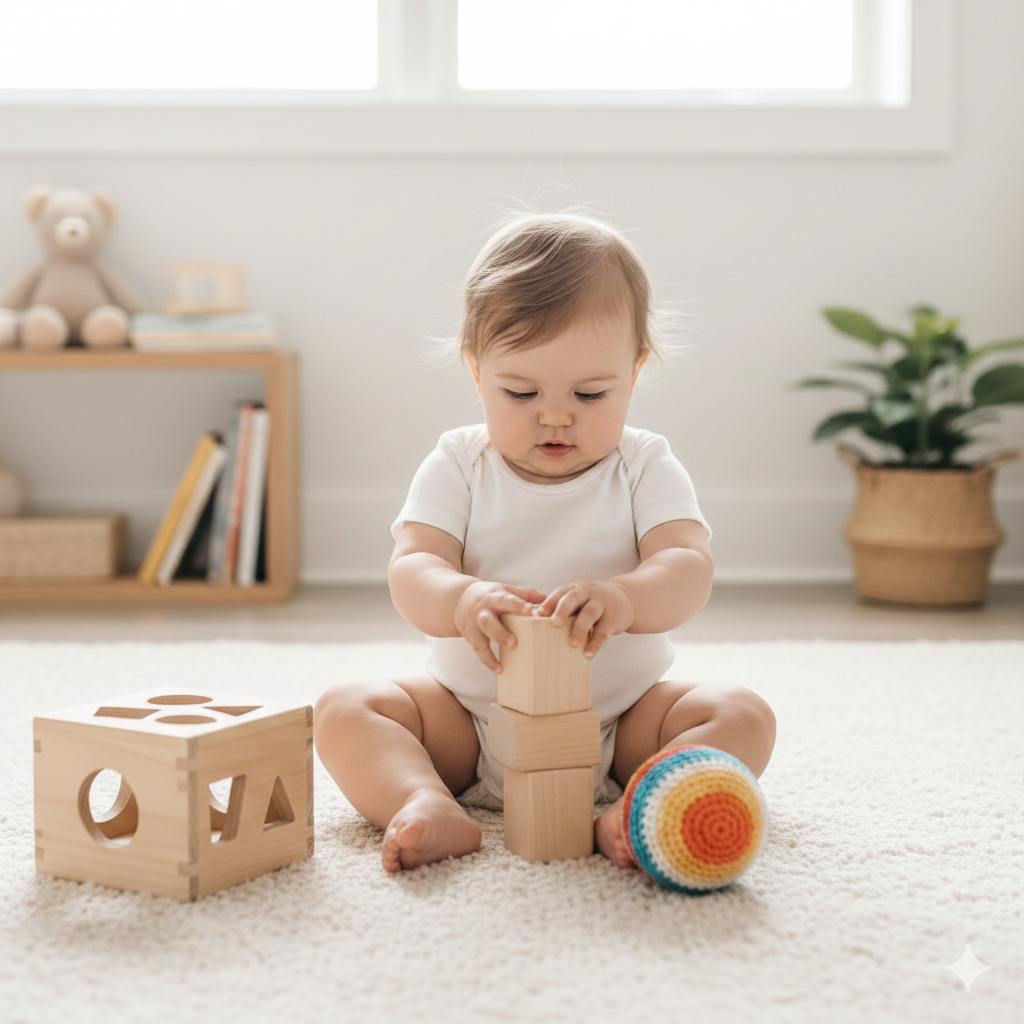
9-12 Months: Sophisticated coordination develops. Babies can stack blocks, place objects in containers, and point at things they want. They understand how to use tools—banging blocks together, pushing buttons, pulling strings. These advances represent significant cognitive and physical development.
Essential Baby Hand Eye Coordination Toys by Stage
Different toys support hand-eye coordination development at different stages.
For Early Reachers (2-4 Months): Toys should be lightweight, easy to see, and hang within reaching distance. Soft, colorful toys suspended from activity gyms encourage batting practice. Even unsuccessful swipes build coordination skills. Handmade crochet toys work beautifully here—they’re lightweight enough that baby can move them with light contact, providing immediate feedback that motivates continued efforts.
For Emerging Graspers (4-6 Months): Toys should be easy to grasp with whole-hand grip. Rattles with handles, soft balls, and textured rings all work well. The key is that successful grasping happens frequently enough to be rewarding but requires enough effort to build skills. Natural materials provide better grip than smooth plastic—the slight texture of crochet or wood helps small hands maintain their hold.
For Precision Developers (6-9 Months): Toys should encourage refined movements. Stacking rings (though baby may not stack them yet), toys with parts that move, and items that fit inside containers all support developing precision. Toys with cause-and-effect elements—push this, something happens—teach that precise actions create specific results.
For Tool Users (9-12 Months): Toys that require problem-solving and multi-step actions support advancing abilities. Shape sorters, simple puzzles, and toys with multiple interactive elements all work well. At this stage, everyday objects often become favorite “toys”—wooden spoons, safe containers, and similar items provide endless coordination practice.
The Advantages of Natural Material Toys
The materials used in Baby Hand Eye Coordination Toys significantly impact their developmental effectiveness.
Better Grip: Natural materials like wood and textured cotton provide superior grip compared to smooth plastic. This matters tremendously when babies are learning to hold objects. The slight texture helps them understand how firmly to grasp—too light and the object slips away, providing clear feedback to adjust their grip.
Appropriate Weight: Natural materials have satisfying weight that helps babies understand cause and effect. When they drop a wooden toy, the sound and impact clearly demonstrate the action’s result. This feedback is crucial for learning about physics and refining motor control. Overly light plastic toys don’t provide the same clear information.
Sensory Feedback: Each material provides unique sensory information—wood feels different from cotton, which differs from natural rubber. This variety helps babies build sophisticated understanding of material properties while practicing coordination. They learn to adjust their approach based on what they’re reaching for.
Safety for Oral Exploration: Babies use their mouths to gather additional sensory information about objects they’re manipulating. Natural materials are inherently safer than plastics that may contain concerning chemicals. This allows unrestricted oral exploration that supports both sensory and coordination development.
Visual Appeal: Natural materials often have subtle color variations and textures that are visually interesting without being overwhelming. This supports sustained attention—babies look longer at items with natural variation compared to uniform synthetic colors.
Activities That Build Hand-Eye Coordination
While toys are important, activities and interactions matter equally.
Supported Reaching: Hold interesting toys just within your baby’s reach. Slowly move them, encouraging tracking and reaching. This controlled practice helps babies understand the relationship between what they see and how to move their hands toward it.
Tummy Time Toys: Place toys at head level during tummy time. This encourages reaching while in prone position, which builds different muscle groups than reaching while on their back. The challenge of lifting both head and arms simultaneously strengthens the coordination system.
Dropping Games: Around 8-9 months, babies love dropping objects and watching what happens. This seemingly repetitive game actually teaches important lessons about gravity, cause and effect, and precision in releasing objects. Provide safe items for dropping and respond with patience to this important learning activity.
Container Play: Offer various safe containers and objects that fit inside them. Putting objects in and taking them out requires precise hand-eye coordination. This activity can occupy babies for surprising lengths of time while building crucial skills.
Interactive Toys: Toys that respond to specific actions—push here to make sound, pull this to make movement—teach that precise actions create predictable results. This understanding motivates the practice necessary to develop coordination.
The Role of Frustration and Persistence
Developing hand-eye coordination involves countless attempts, many failures, and gradual improvement. How parents respond to babies’ frustration during this process significantly impacts development.
Babies will miss objects they reach for. They’ll drop things they meant to hold. They’ll struggle to place one block on another. These frustrations are essential parts of learning. Your role is supporting persistence without eliminating appropriate challenge.
When your baby misses an object they reached for, resist the urge to immediately place it in their hand. Instead, encourage another attempt. Offer verbal support—”Almost! Try again”—and position the toy to maximize success probability without guaranteeing it. The learning happens in the effort, not just the success.
Watch for signs of genuine distress versus productive frustration. Fussing while continuing to try indicates engagement with appropriate challenge. Crying and giving up suggests the task may be too difficult for their current abilities. Adjusting difficulty based on these cues ensures practice remains productive rather than discouraging.
The Connection to Later Academic Skills
The hand-eye coordination developed through play in infancy directly impacts later academic success, though the connection isn’t always obvious.
Reading Skills: Efficient reading requires smooth eye tracking across lines of text. This ability begins developing during infancy when babies track moving toys. Early tracking practice literally builds the neural pathways later used for reading.
Writing Skills: Obviously, writing requires precise hand-eye coordination. The progression from whole-hand grasping to pincer grip to controlled tool use that occurs during infancy creates the foundation for later pencil control.
Mathematics: Manipulating objects—moving them, sorting them, combining groups—supports early mathematical thinking. The spatial reasoning developed through block play and shape sorting underlies later geometry and spatial mathematics.
Science Skills: Experimentation requires careful observation and precise manipulation. The cause-and-effect understanding developed through coordinated play becomes the foundation for scientific thinking.
Special Considerations for Different Learners
While most babies follow similar developmental progressions, individual differences matter.
Premature Babies: Babies born prematurely may reach coordination milestones later than their chronological age would suggest. Use their adjusted age (age from due date rather than birth date) when assessing development and choosing toys. They need the same progression of experiences, just on a different timeline.
Babies with Visual Challenges: Babies with visual impairments still develop hand-eye coordination, though they may rely more heavily on other sensory input. Toys with strong auditory or tactile elements support their development. Consultation with early intervention specialists provides personalized strategies.
Babies with Motor Challenges: Some babies have conditions affecting muscle tone or motor control. They still benefit from coordination practice but may need adapted toys or activities. Occupational therapists can recommend specific toys and techniques suited to individual needs.
Highly Active Babies: Some babies are naturally more active and may reach motor milestones earlier. They need abundant opportunity for practice and may frustrate easily with toys that don’t provide sufficient challenge. Offering slightly advanced toys keeps them engaged.
Cautious Babies: Other babies approach new motor challenges more tentatively. They benefit from extended time with each developmental stage before advancing to new challenges. Patient support without pressure helps them develop confidence alongside coordination.
The Impact of Screen Time
Modern parents face questions about screen time’s impact on coordination development. Research increasingly suggests significant concerns.
Screens provide no opportunities for the hand-eye coordination practice that physical toys offer. Swiping a tablet doesn’t build the same skills as grasping and manipulating three-dimensional objects. The visual input from screens doesn’t support the same neural development as observing and interacting with real objects in three-dimensional space.
The American Academy of Pediatrics recommends no screen time for children under 18 months (except video chatting). This recommendation reflects understanding that critical development during this period requires real-world sensory and motor experiences that screens cannot provide.
Prioritizing physical toys and activities over screen exposure ensures babies get the experiences necessary for optimal coordination development. The skills built through physical play transfer broadly across contexts. Screen-based “coordination” does not.
Measuring Progress and Celebrating Milestones
Parents often wonder if their baby’s coordination is developing typically. While individual variation is normal, certain milestones indicate healthy development.
By 4 months, babies should deliberately reach for objects within view, even if they miss frequently. By 6 months, successful grasping should occur regularly. By 9 months, the pincer grasp should emerge. By 12 months, babies should stack at least two blocks and place objects in containers intentionally.
If you have concerns about your baby’s coordination development, trust your instincts and consult your pediatrician. Early intervention for coordination delays significantly improves outcomes. Occupational therapists specializing in pediatrics can assess development and provide targeted support if needed.
For babies developing typically, celebrate each new coordination achievement. The first successful grasp, the first object transfer between hands, the first block stacked—these milestones represent significant neural development and hard work by your baby.
Choosing Quality Over Quantity
The toy market offers overwhelming options for coordination development. Rather than accumulating dozens of toys, focus on quality items that serve multiple developmental purposes.
A few well-chosen natural material toys provide more value than many cheap plastic alternatives. A handmade crochet ball serves coordination practice, sensory exploration, and even early ball games as your baby grows. A set of wooden blocks supports coordination, problem-solving, and eventually imaginative play. Quality toys adapt as babies’ abilities develop.
This selective approach also creates calmer environments. Visual clutter from too many toys can actually hinder focus and sustained engagement. A few interesting toys rotated regularly maintains novelty without overwhelming.
Conclusion: Coordination as Foundation
Hand-eye coordination development during infancy creates foundations for countless later skills. The neural pathways built through repeated reaching, grasping, and manipulating objects serve your child throughout their life—in academics, sports, arts, work, and daily living.
Providing appropriate toys and activities that support this development is one of the most valuable investments you can make in your child’s future. While babies will develop coordination to some degree regardless, thoughtfully chosen toys and engaged parent interaction optimize this development.
The coordination your baby builds during these early months becomes invisible later—they don’t consciously think about coordinating hand and eye movements any more than they think about breathing. But this automatic, efficient coordination underlies everything they do. You’re building future capabilities during these playful early months.
Why Us
Skill-Building Design
Handmade toys and essentials that support fine motor skills, hand-eye coordination, and sensory play.
Natural & Safe Materials
Soft, breathable cotton and bamboo yarns—gentle on babies and made with care.
Impact With Every Purchase
We empower women artisans and create responsible products aligned with key SDGs.